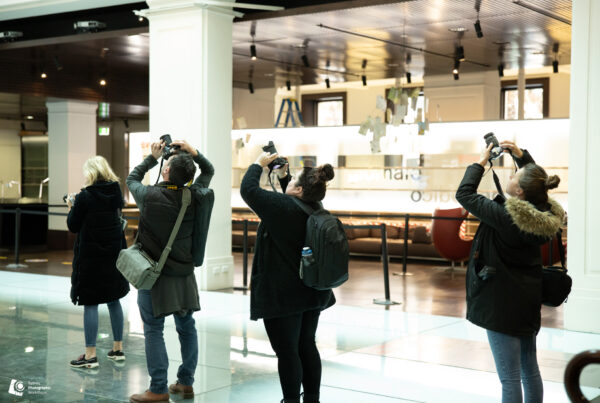
Composition is how you arrange elements within your frame to create impact. The rules are not rigid laws — they are tools. The rule of thirds, leading lines, framing, symmetry and negative space are the foundational techniques beginners learn to apply in the field. Once you understand them, you can break them intentionally. Sydney Photographic Workshops teaches these techniques hands-on every week around Sydney Harbour and the Harbour Foreshore.
This article covers:
What Is Composition in Photography and Why Does It Matter?
Composition is the art of arranging visual elements within your frame to create a photograph that communicates something. It is the difference between a photo that makes someone stop scrolling and one that gets skipped. Technical perfection without composition produces sharp, correctly exposed images that nobody cares about.
The difference between a snapshot and a photograph
A snapshot records what was there. A photograph decides what to include, what to exclude, where to place the subject, and how to use space and light to direct attention. Composition is that decision-making process. It happens before you press the shutter.
The Rule of Thirds: Your First Composition Tool
The rule of thirds divides your frame into a 3×3 grid. Placing your main subject on one of the four intersection points rather than dead centre creates a more natural, dynamic image. It works because it mirrors how we naturally scan a scene.
How to use gridlines on your DSLR or mirrorless camera
Most cameras can display a rule-of-thirds grid directly on the screen or in the viewfinder. On Canon: Menu > Shooting Settings > Grid Display. On Sony: Menu > Display/Auto Review > Grid Line. On Nikon: Menu > Custom Settings > Framing Grid Display. Enable it now — it costs nothing and immediately improves how you frame shots.
Where to place your subject for stronger images
For portraits, place the subject’s eyes on the upper-third line. For landscapes, place the horizon on the upper or lower third, not the middle. For street photography, give your subject space to move into by placing them off-centre in the direction they are walking or looking.
Leading Lines: Guide the Viewer’s Eye Through the Frame
Leading lines are any lines that draw the viewer’s eye from one part of the frame toward another — usually toward your main subject. Roads, fences, paths, rivers, stairways, corridors, shorelines and architectural edges all function as leading lines. They add depth and purpose to an otherwise flat image.
Finding leading lines around Sydney
Sydney is a leading-line goldmine. The Sydney Harbour Bridge creates powerful converging lines. The curved walkway along Pyrmont Bay is a natural S-curve. The Rocks laneways are tight and moody. At our photography workshop, you will shoot all of these in a single 4-hour afternoon session around the Harbour Foreshore.
Framing: Using Foreground Elements to Add Depth
Framing uses elements in the foreground or middle ground to create a natural frame around your subject. Doorways, arches, overhanging branches, windows, tunnels — anything that encircles or partially encloses your subject. The frame-within-a-frame technique draws attention inward and creates an instant sense of depth and context.
Symmetry and Patterns: When Balance Creates Power
Symmetry rewards centred compositions in the right context — directly contradicting the rule of thirds. Reflections, architecture, long corridors, and formal gardens often work best placed dead-centre, where the symmetry is the point. Patterns — repeated elements like tiles, windows, or leaves — work best when you interrupt them: a single anomaly in a repeating pattern creates immediate visual tension.
Negative Space: Letting the Empty Tell the Story
Negative space is the empty area surrounding your subject. Most beginners try to fill every corner of the frame. Professional photographers do the opposite: they strip everything back, leaving space that emphasises scale, isolation, or calm. Space is not absence — it is a compositional element in its own right.
Composition Rules Worth Breaking — and When
| Rule | When to break it | Effect |
|---|---|---|
| Rule of thirds | Symmetrical subjects, reflections | Creates balance and calm |
| Horizon on a third | Flat, featureless foreground | Sky becomes the story |
| Don’t centre your subject | Strong symmetrical architecture | Intentional, graphic impact |
| Leave space ahead of subject | Trapped or confined feeling is the intent | Creates tension |
Common questions about composition in photography
What does composition mean in photography?
Composition is the deliberate arrangement of visual elements within your frame — subject, foreground, background, light and space — to create an image that guides the viewer’s eye and communicates intent.
Is the rule of thirds a hard rule?
No. It’s a guideline that trains your eye. Once you understand why it works, you can break it intentionally. Centred symmetrical compositions, for example, often work better for architectural or reflective subjects.
How do I show gridlines on my camera screen?
On most Canon, Nikon and Sony cameras, gridlines can be activated in the Display Settings or Shooting Menu. Check your camera manual for the exact path — it takes under a minute to enable.
What are leading lines in photography?
Leading lines are any linear element — roads, fences, rivers, railway lines, corridors — that draw the viewer’s eye from the edge of the frame toward your main subject, adding depth and direction.
What is negative space and how do I use it?
Negative space is the empty area around your subject. Used intentionally, it creates visual breathing room, emphasises scale or isolation, and directs focus to what matters in the frame.
Can composition be taught in a photography course?
Yes — and it’s best learned in the field, not from a textbook. SPW’s courses build composition practice into every practical session, including the Harbour Foreshore field trip in Week 6 of the 8-week course.
What is the best composition technique for portraits?
For portraits, the rule of thirds (eye on the upper intersection point), negative space for storytelling, and eye-level framing are the most reliable starting points. Advanced techniques like environmental framing add depth.
Where can I practise composition techniques in Sydney?
Sydney Harbour Foreshore, The Rocks, Pyrmont, Glebe and the city’s laneways all offer strong leading lines, architectural symmetry, and varied light. SPW’s Photography Essentials workshop covers these locations in a guided 4-hour session.
Interested in putting composition into practice?
SPW’s beginner courses put composition into practice every session. Shoot the rule of thirds, leading lines and framing around Sydney Harbour Foreshore with an award-winning tutor.